The library does half the work
Why studying in the same place makes starting easier, and what NoTestudo can and can’t see about your study time.
The NoTestudo team
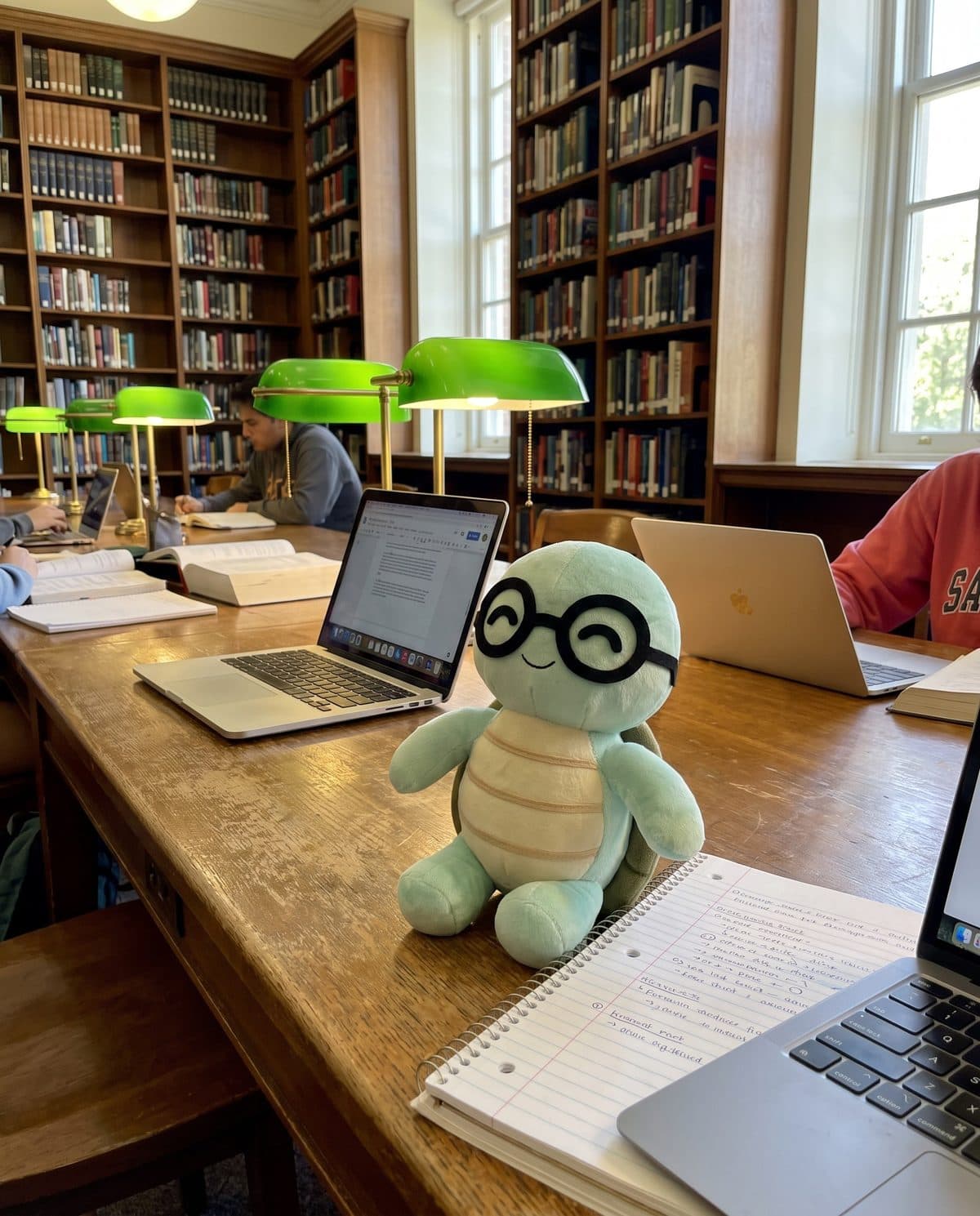
The hardest part of studying is usually the first ten minutes. Once you’re into a problem set, momentum carries you. Getting there is the problem: the phone, the bed that’s right there, the sudden urge to reorganize your desk.
That’s where a dedicated study place earns its keep.
Places start behaviors
Habits form as people repeat the same action in the same context, and habit researchers describe them as an efficient, default way of acting: once a habit is in place, it runs with less deliberate effort than a fresh decision.1
For studying, that means the place can do part of the starting for you. If a particular table at the library has been where you work, sitting down there makes working the obvious next step. Your bed, where you sleep and scroll, cues something else entirely.
A strange and famous experiment
There’s a classic study about how much context sticks to what we learn. In 1975, researchers had divers learn lists of words either on land or underwater, then recall them in one place or the other. Words learned underwater were recalled best underwater, and words learned on land were recalled best on land.2
You probably won’t be taking exams underwater. Still, it’s a good reminder that where you study is part of the experience.
Building a library habit
- Pick one or two spots and keep them: same floor, same kind of table, if you can. A consistent setting is what lets the place do its work.
- Tie the trip to something that already happens: “After my last class on Monday, Wednesday and Friday, I walk to the library.”
- Keep studying and sleeping in different places when you can.
- Bring only what the session needs. If the phone is the problem, the bottom of your bag is farther away than the table.
- Set a weekly target. “Six hours a week” can flex around a heavy Tuesday or a short Friday.
Match the spot to the work
Not every kind of studying wants the same place. It can help to have a small set of spots, each with its own job:
- A quiet floor for reading and writing, where nobody you know is likely to wander by.
- A group room or a big table for problem sets, when talking it through is the point. If you study with friends, a group with a shared goal can make the standing plan stick.
- A “last stop” spot near home for lighter review at the end of the day, so a late session doesn’t mean a long walk back. (More on late nights in the turtle’s column on sleep.)
Whatever the set looks like, keep each spot’s job consistent. A table that’s sometimes for studying and sometimes for scrolling is a weaker cue than one that’s only ever for work.
What NoTestudo sees, and what it doesn’t
In NoTestudo, a study goal is tied to the places where you study, like a campus library. The app notices when you arrive and leave, and confirmed time there adds up as time invested.
To be clear about the limits: NoTestudo can’t see studying itself, but it can notice time at McKeldin Library. Three hours there is three hours there, whether you were deep in organic chemistry or deep in a group chat. The app doesn’t pretend otherwise, and it never judges what you did with the time.
That turns out to be useful. When you look back at a week with plenty of library hours that didn’t feel productive, the question gets specific: what happened at the table? Maybe the spot is too social. Maybe two-hour stretches are too long. The record gives you the where and the how long. You bring the why.
For habits that don’t happen at a place, like reading before bed, there are quick check-ins.
“Showing up is the hard part. Done.”

When the library isn’t an option
Not everyone can get to a library every day, and that’s fine. The principle travels. A corner of a dining hall after the lunch rush, a quiet lounge in your building, a particular desk at a coffee shop: what matters is that the place is consistent and mostly used for one thing. In NoTestudo, any of those can be a place for your study goal, and the time adds up the same way.
Try this
Choose one study spot this week and use it for every session. Next Sunday, look at your time there and ask one question: was that the right spot?
References
- Wood, W., & Rünger, D. (2016). Psychology of habit. Annual Review of Psychology, 67, 289–314. https://doi.org/10.1146/annurev-psych-122414-033417 (opens in a new tab)
- Godden, D. R., & Baddeley, A. D. (1975). Context-dependent memory in two natural environments: On land and underwater. British Journal of Psychology, 66(3), 325–331. https://doi.org/10.1111/j.2044-8295.1975.tb01468.x (opens in a new tab)