Groups that don’t need your location
Accountability helps, and it doesn’t require anyone to see where you are. How NoTestudo groups share streaks and on-track days, and nothing else.
The NoTestudo team

There’s a reason study groups, running clubs and gym buddies are so common. Knowing someone will notice whether you showed up makes showing up a little easier.
There’s also a version of accountability that goes too far. Location-sharing apps can turn “let’s keep each other honest” into “I know exactly where you were at 11 p.m.,” which isn’t what most people signed up for. The part that helps doesn’t need anyone’s location at all.
What the research says about sharing progress
A 2016 review of 138 experiments found that monitoring progress toward a goal helped people reach it, and that the effect was larger when progress was reported to others or made public.1
Notice what that finding is about: progress. Nothing in it requires a map of anyone’s day. A friend knowing you hit the library four times this week is the useful part. A friend knowing which table you sat at, and when you left, is not.
How NoTestudo groups work
Groups in NoTestudo are built around a shared goal: a study circle, a gym crew, a few friends cutting back on takeout together. This is what a group can and can’t see:
- Groups see your streak and your on-track days.
- Groups never see your places, your visits or your money saved.
- Sharing is off until you turn it on for a group.
- Friends are added with a code, not your phone number. Your code, not your number.
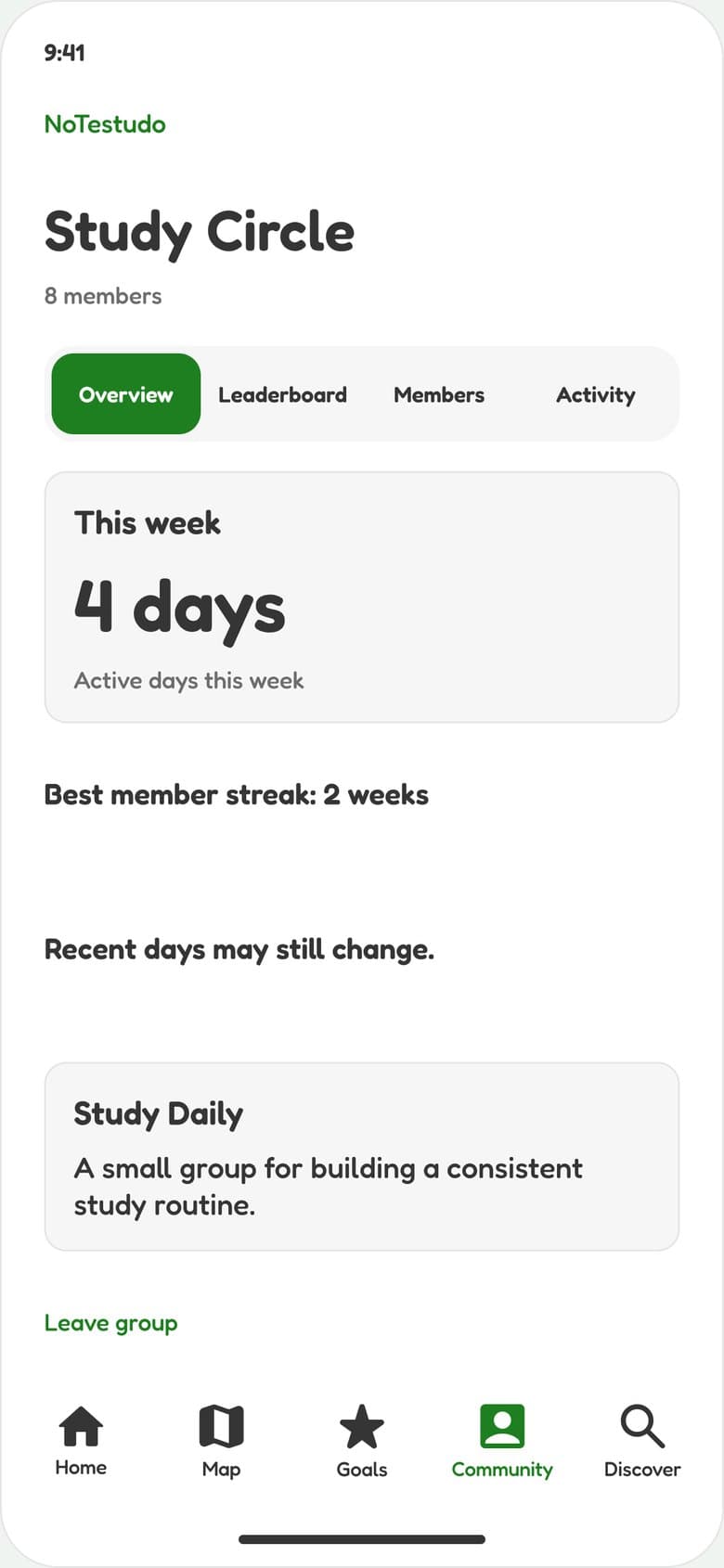
Each group also has a weekly board of confirmed days, so you can see who made it this week. It’s not about shaming anyone. Think of it as a nudge: if your whole study circle made it to the library four days this week, that’s a nice thing to know on Sunday night.
Location sharing with friends is a separate setting. It’s opt-in for each friend, with a choice between an exact place and an approximate area, and it’s available in the newest beta. Health-care places are never shared.
Accountability without surveillance
It helps to name what good accountability looks like, so you can tell when a group, or an app, starts drifting away from it:
- It’s opt-in. Nothing should be shared by default. You choose what a group sees, and you can change your mind.
- It’s about the goal. What’s shared is progress on the thing you agreed to work on together, not the rest of your life.
- It’s kind. A board of confirmed days should make it easier to cheer for each other. If it ever starts to feel like a contest, say so.
- It leaves your places alone. Where you went is yours. Whether you showed up for the shared goal is the only part a group needs.
Making a group help
A group is only as useful as the habits around it. A few ideas:
- Keep it small. A handful of people who know each other is easier to keep up with than a crowd.
- Share one goal. A group for “library four days a week” gives everyone the same thing to cheer for.
- Celebrate out loud when someone hits a streak. Congratulate first, compare never.
- Make a standing plan. “Library, Tuesday and Thursday, right after our 2 p.m.” gives the group a place and a time to go with the chat.
- Go easy on misses. Someone will have a rough week, and a quick “we missed you” beats silence, which still beats a lecture.
Starting with a few friends
You don’t need a big group to get the benefit. Two or three friends working on the same thing is plenty. Share your friend code (your code, not your number), agree on one goal, and pick a standing time and place to show up together.
Then decide, out loud, how you want to handle the misses. Some groups like a gentle check-in when someone’s quiet for a week. Others would rather nobody mention it. Either is fine. What matters is that everyone agreed to it.
Finding your study circle
In NoTestudo, groups live in the Community tab, and you can find more in Discover. Find your study circle, agree on the goal, and let the board of confirmed days do the nudging. Your places stay yours.
The short version
Groups see your streak and on-track days, never your places, visits or money saved. Sharing is off until you turn it on for a group.
References
- Harkin, B., Webb, T. L., Chang, B. P. I., Prestwich, A., Conner, M., Kellar, I., Benn, Y., & Sheeran, P. (2016). Does monitoring goal progress promote goal attainment? A meta-analysis of the experimental evidence. Psychological Bulletin, 142(2), 198–229. https://doi.org/10.1037/bul0000025 (opens in a new tab)