Go to bed. I’ll keep watch.
The NoTestudo turtle on late nights, the places that keep you up, and why the 2 a.m. library session isn’t always the win it feels like.
Mascot and occasional columnist
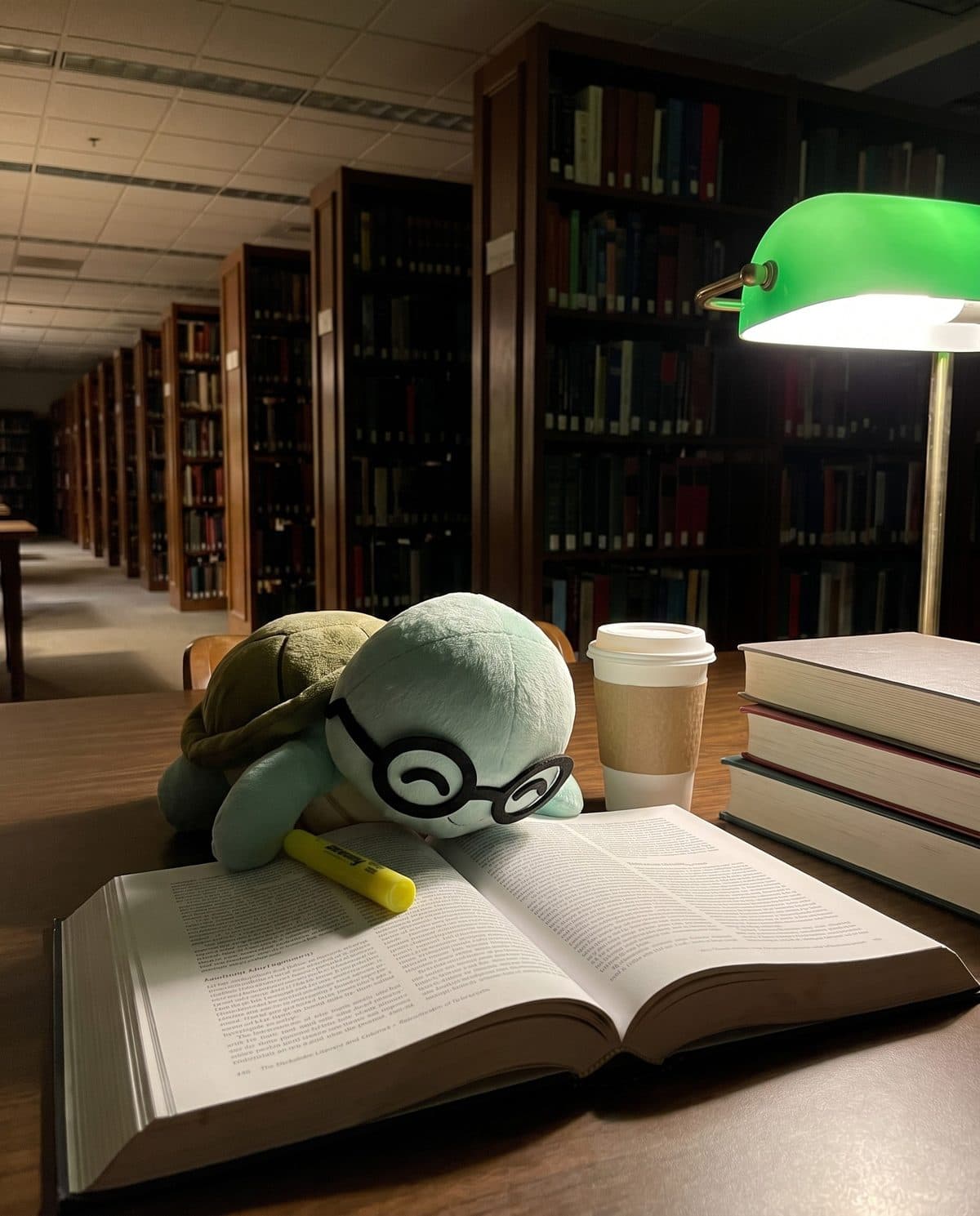
Hi, I’m NoTestudo. I’m a turtle, so I know a thing or two about taking it slow. Something I’ve noticed about campus: some of the longest nights of the week don’t happen at parties. They happen at a library table at 2 a.m., in a dorm lounge, or in a booth at the place that sells fries until 3.
I’m not here to tell you to stop. Sometimes the late night is the right call. I just want to make the case for sleep, because tomorrow’s plans tend to start with tonight’s.
How much sleep, really
The grown-up numbers come from people who study this for a living. A National Sleep Foundation expert panel recommends 7 to 9 hours for young adults.1 The American Academy of Sleep Medicine and the Sleep Research Society say adults should sleep 7 or more hours a night on a regular basis.2
College is a tough place to hit those numbers. A 2014 review of research on college students’ sleep reported that about half of students report daytime sleepiness, and about 70% don’t get enough sleep.3 So if you’re tired, you have company. Lots of it.
Late nights have addresses too
My turtle take: nights don’t just run late. They run late somewhere: the library that’s open until 2, the friend’s room where the game is still going, the late-night food spot that’s always one more stop. Places shape bedtime the same way they shape everything else.
Which means the fix can be a place too:
- Pick a leaving time. “I leave the library at 11” is easier to keep than “I’ll be asleep by midnight,” because you can see the door.
- Make home the next stop. If your nights tend to end with one more place, decide ahead of time that home comes right after the library.
- Let your bed be a bed. If it’s also your desk, your couch and your dining table, it has too many jobs. Give studying somewhere else to happen.
- Plan tomorrow’s first place tonight. Knowing where you’re headed at 9 a.m. makes it easier to call it a night.
About the 2 a.m. library session
I love a library. Big fan. But a 2 a.m. session can feel more productive than it is. You’re there, the lights are on, the hours are adding up… and you’re reading the same paragraph for the fourth time.
In NoTestudo, library time counts as time invested toward a study goal. That time is real, and it’s yours. But the app can’t see studying itself, only time at the library. So if your week shows a lot of very late hours, ask whether they were good hours. Sometimes the best study session is the one you start well rested the next morning.
When you have to stay late
Finals happen. Deadlines happen. If a late night is coming no matter what, you can still make it a better one:
- End close to home. Move to a spot near where you live for the last stretch, so the walk back is short.
- Decide the stopping point first: “until this problem set is done” or “until 1 a.m., whichever comes first.”
- Protect the next morning if you can, with a later start, an easier first hour, no 8 a.m. heroics on four hours of sleep.
The same 2014 review covers ways students and colleges can cut down on sleepiness, including sleep education, naps and adjusting class times.3 You can’t move your class schedule tonight. You can move where your night ends.
The morning-after test
A trick for telling a good late night from a costly one: NoTestudo’s daily recap is ready the morning after, so take a look at it with your coffee. Last night’s three library hours are there. Now ask how this morning is going. Did you make your first class? Can you think in full sentences? If the answer is no, last night’s hours may have been borrowed from today.
One morning won’t tell you much. A few weeks of them will. If your late nights keep showing up next to rough mornings, that’s a pattern, and patterns are something you can plan around.
My bedtime routine (you can borrow it)
- Decide when you’re leaving wherever you are.
- Go home. No detours. Okay, one detour, if it’s for a glass of water.
- Pack tomorrow’s bag.
- Put your phone across the room.
- Lights out.
Five steps. Even I can do it, and I have very short legs.
And if you need one more reason:
“Go to bed. I’ll keep watch.”
A note from the team
This column is written by the NoTestudo team in the turtle’s voice. It isn’t medical advice. If sleep problems are getting in the way of your days, a doctor or your campus health center can help.
References
- Hirshkowitz, M., Whiton, K., Albert, S. M., et al. (2015). National Sleep Foundation’s sleep time duration recommendations: Methodology and results summary. Sleep Health, 1(1), 40–43. https://doi.org/10.1016/j.sleh.2014.12.010 (opens in a new tab)
- Watson, N. F., Badr, M. S., Belenky, G., et al. (2015). Recommended amount of sleep for a healthy adult: A joint consensus statement of the American Academy of Sleep Medicine and Sleep Research Society. Sleep, 38(6), 843–844. https://doi.org/10.5665/sleep.4716 (opens in a new tab)
- Hershner, S. D., & Chervin, R. D. (2014). Causes and consequences of sleepiness among college students. Nature and Science of Sleep, 6, 73–84. https://doi.org/10.2147/NSS.S62907 (opens in a new tab)