No bars on weeknights
A place-based plan for drinking less during the week: pick the nights, plan the route home, and let the record show you the pattern.
The NoTestudo team
Midweek drinking often isn’t one big decision. It’s a Tuesday trivia night that runs late, a “one drink?” text on Wednesday, a Thursday that’s practically the weekend. If you’ve decided you want fewer of those nights, the most useful thing to plan around might be the bar rather than the drink.
Before we start
This piece is about cutting back on bar nights as a habit. It isn’t medical advice, and NoTestudo isn’t diagnosis, treatment or crisis care. If you’re worried about your drinking, the resources at the end of this article are a good place to start.
Why the place matters
Habits are tied to the settings where they happen. Once a routine is established, being in a familiar context can set it off without much of a decision at all.1 That’s why “drink less” is hard to stick to at 10 p.m. inside the bar, and much easier at 6 p.m., when you’re still deciding where to go.
So instead of a rule about drinks, try a rule about places. “No bars on weeknights” is clear, it’s easy to check, and it still leaves the weekend for whatever you decide the weekend is for.
Plan the week ahead
- Decide on Sunday which nights are going-out nights. On every other night, the answer is already made.
- Plan the route home. If your walk from the library passes your usual spot, take a different street; it’s much easier not to go in when you never walk past the door.
- Have a standing alternative, like a pickup game or a late dinner with friends. Weeknights need somewhere good to be.
- Use an if-then plan for invitations: “If someone texts ‘one drink?’ on a weeknight, I’ll suggest Friday instead.” A plan in this form decides what you’ll do before the moment arrives.2
Count clear days
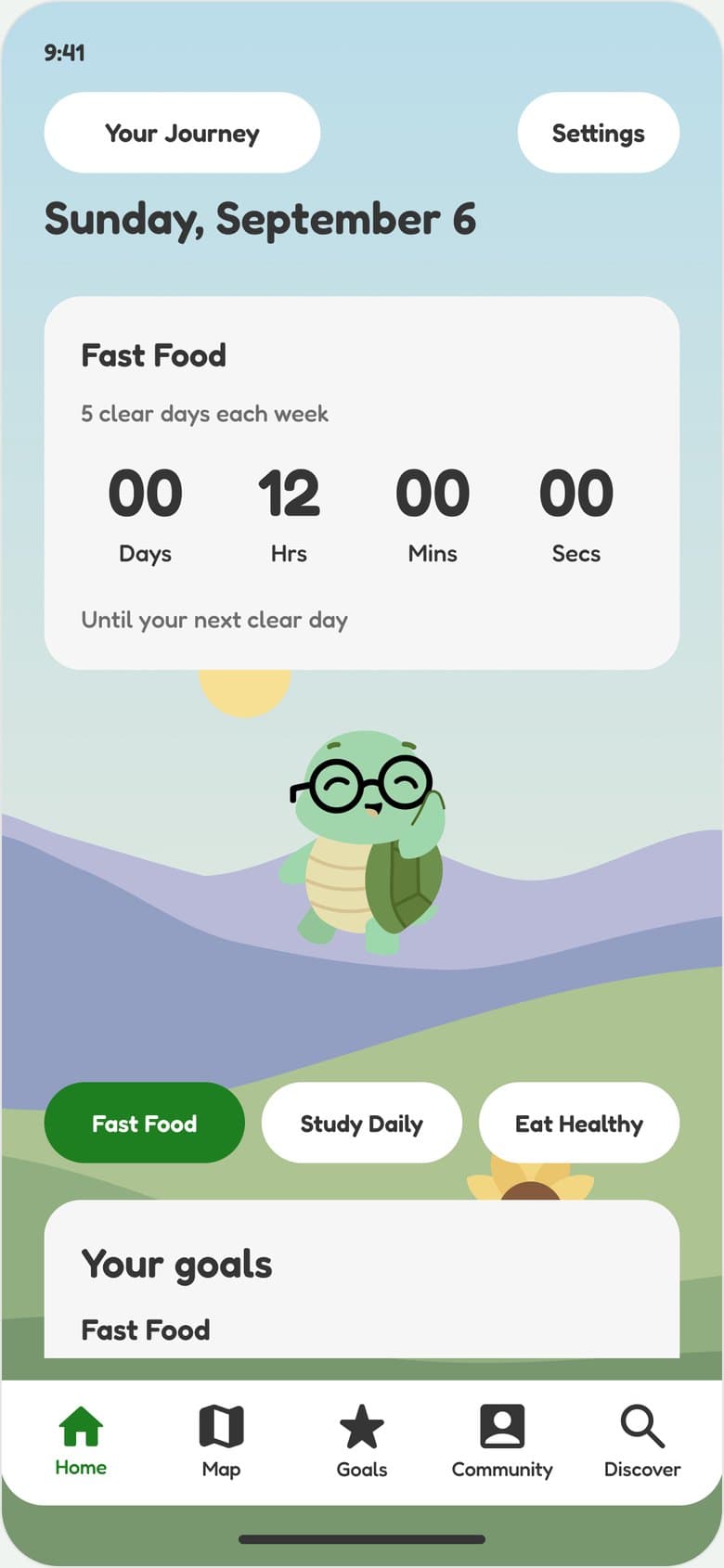
Cutting back is hard to measure, because you’re counting something that didn’t happen. A clear day helps: a day you didn’t go to the places you’re cutting back on. “Five clear days a week” turns the goal into something you count up to.
In NoTestudo, you add the bars, clubs or liquor stores you want less of in your week, and the app notices visits on its own. Stays under three minutes look like passing by, so walking past doesn’t count. Home shows a countdown to your next clear day, and badges mark the small wins, like your first clear day.
Let the turtle notice, kindly
In the newest beta, NoTestudo’s turtle reacts to where you are, in the tone you pick. Playful mode might raise an eyebrow at you. Gentle mode just notices: “You’re at the bar. No judgment, just noticing.”
“One stop doesn’t define your week.”

What to say when friends ask
The hardest part of a weeknight rule is often the social side. It helps to have a line ready, so you’re not inventing one on the spot:
- “I’m doing a no-weeknights thing this month. Friday?”
- “Can’t tonight, but I’m in for the game on Saturday.”
- “I’ll come for food, not the bar.”
You don’t owe anyone a longer explanation than that. And you might find that suggesting another night, or another place, works for more people than you’d expect.
Look at the pattern on Sunday
After a few weeks, the record shows which nights tend to turn into bar nights and what came before them. Maybe it’s always the night after a hard exam, or the night a certain group chat gets going. None of that is a judgment, and it’s the most useful thing to know when you plan next week.
If the same night keeps going sideways, plan that night first. A standing Thursday plan somewhere else does more than a promise you make to yourself on Wednesday. And if Friday is the night you want to go out, put it on the plan too. A night you chose on Sunday is a different thing from a night that happened to you.
If it’s more than a habit
Sometimes cutting back on bar nights is a habit project. Sometimes it’s harder than that, and that deserves to be taken seriously. If you’re worried about your drinking:
- The National Institute on Alcohol Abuse and Alcoholism’s Rethinking Drinking (opens in a new tab) site has standard-drink guides, calculators and tips for cutting back.3
- SAMHSA’s National Helpline, 1-800-662-4357, is a free, confidential, 24/7 treatment referral and information service, in English and Spanish.4
- If you’re in crisis, call or text 988 to reach the 988 Suicide & Crisis Lifeline, any time.
References
- Wood, W., & Neal, D. T. (2007). A new look at habits and the habit–goal interface. Psychological Review, 114(4), 843–863. https://doi.org/10.1037/0033-295X.114.4.843 (opens in a new tab)
- Gollwitzer, P. M. (1999). Implementation intentions: Strong effects of simple plans. American Psychologist, 54(7), 493–503. https://doi.org/10.1037/0003-066X.54.7.493 (opens in a new tab)
- National Institute on Alcohol Abuse and Alcoholism. Rethinking Drinking. https://www.rethinkingdrinking.niaaa.nih.gov/ (opens in a new tab)
- Substance Abuse and Mental Health Services Administration. SAMHSA’s National Helpline. https://www.samhsa.gov/find-help/helplines/national-helpline (opens in a new tab)