Go more, go less: one week, two directions
Some goals are about showing up more. Some are about showing up less. How to set up both around real places, starting with the gym.
The NoTestudo team

“Get in shape” is a fine thing to want and a hard thing to plan. It doesn’t say where, when or how often, so it’s easy to agree with on Sunday and forget by Tuesday.
A more useful question is: which places decide this goal? For fitness, that’s usually the gym, the field or the trail. Sometimes it’s also a place you’d like to visit less, like the drive-thru that keeps replacing dinner after practice. Every place goal runs one of two ways. Go more, or go less.
Going more: make it a weekly target
A “go more” goal works best as a weekly number tied to a specific place. “Go to the gym three times a week” is a plan. “Work out more” is a wish.
- Start from your real week. If you went once last week, three is a stretch, and two might be the right first target.
- Count time as well as trips. Thirty minutes at the rec center and two hours there are different weeks, and time invested shows the difference.
- Pick a place you already pass. The gym on your way often beats the one with better equipment.
Going less: count clear days
“Go less” goals are trickier, because what you’re tracking is an absence. A useful unit is the clear day: a day you didn’t stop at the place you’re cutting back on. “Five clear days a week” is concrete, leaves room for real life, and gives you something to count up to instead of a rule to break.
Write the plan as if-then
Whichever way a goal runs, the plan gets sturdier when it names a situation and a response. Psychologist Peter Gollwitzer calls these implementation intentions: plans in the form “when situation X arises, I will do Y.”1 A 2006 review that pooled 94 independent tests found that forming plans like this had a medium-to-large effect on reaching goals.2
For a fitness goal, that might look like:
- “When my last class ends on Tuesday and Thursday, I’ll walk straight to the rec center.”
- “If practice runs late, I’ll eat at the dining hall instead of driving through.”
- “When I get back to my room and want to sit down, I’ll change into gym clothes first.”
Each one hangs the goal on a moment that’s going to happen anyway, so you don’t have to remember it at the right time.
Pair the place with something you like
One more idea, and it comes with a great study title. In “Holding the Hunger Games Hostage at the Gym,” researchers gave people page-turner audiobooks they could only listen to at the gym. At first, those people visited the gym 51% more often than a control group. The boost faded over time, especially after Thanksgiving, but it shows how much a small reward tied to a place can matter.3
Save a podcast, a playlist or a show for the treadmill only, and the gym becomes the place where one of the good parts of your week happens.
Put both directions in one week
The two directions often belong together. If the drive-thru after practice is what usually replaces the gym, a plan that only says “gym three times” leaves the real competition untouched. A plan that says “rec center three times, drive-thru at most once” names both places, and the week makes a lot more sense when you look back at it.
Start with one of each, not five of each. You can always add places later. A short plan you can follow tells you more about your week than a long one you abandon.
Setting it up in NoTestudo
In NoTestudo, goals work exactly this way. Say what you want in your own words, and the app turns it into places to visit more and places to visit less, each with a weekly target. A goal you’re building counts time at its places. A goal you’re cutting back on counts clear days.
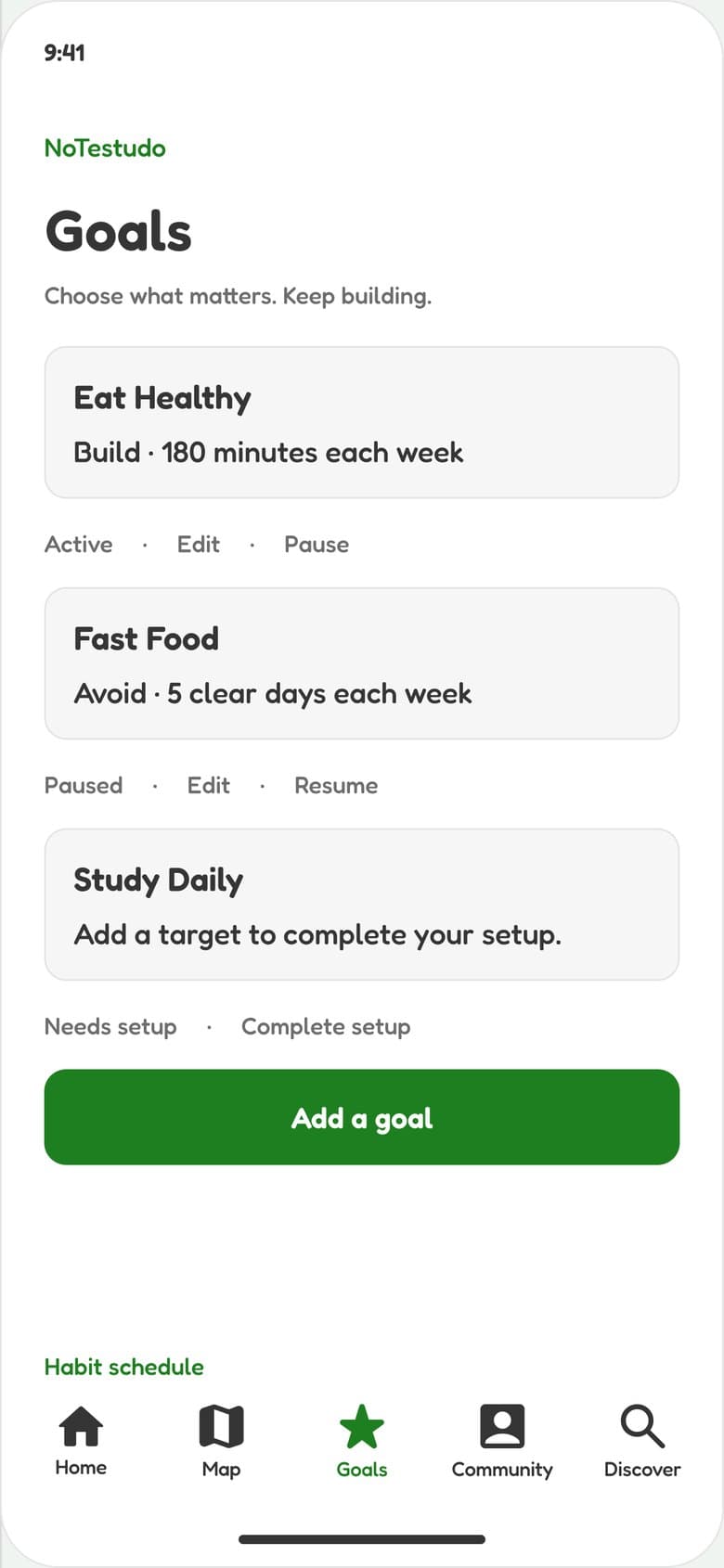
Visits record on their own when you arrive and leave, so gym days add up without a single check-in. Your first week of visits becomes the starting point, so progress compares you with you.
Try this
Pick one place to go more and one place to go less this week. Write one if-then plan for each. On Sunday, look at what happened before you change anything.
References
- Gollwitzer, P. M. (1999). Implementation intentions: Strong effects of simple plans. American Psychologist, 54(7), 493–503. https://doi.org/10.1037/0003-066X.54.7.493 (opens in a new tab)
- Gollwitzer, P. M., & Sheeran, P. (2006). Implementation intentions and goal achievement: A meta-analysis of effects and processes. Advances in Experimental Social Psychology, 38, 69–119. https://doi.org/10.1016/S0065-2601(06)38002-1 (opens in a new tab)
- Milkman, K. L., Minson, J. A., & Volpp, K. G. M. (2014). Holding the Hunger Games hostage at the gym: An evaluation of temptation bundling. Management Science, 60(2), 283–299. https://doi.org/10.1287/mnsc.2013.1784 (opens in a new tab)