The hours and dollars you keep
Hours and dollars kept, never a score. What NoTestudo’s numbers mean, how they’re worked out, and what they can’t tell you.
The NoTestudo team

Many habit apps measure progress in their own currency: levels, flames, a ring that fills up. The trouble is that none of it exists outside the app. You can’t spend a level, and a full ring doesn’t give you an evening back.
NoTestudo measures progress in two things you already care about, time and money. This is how each number works, and where each one stops.
Time invested
For goals where you want to go somewhere more, like the library or the gym, NoTestudo adds up confirmed time at the places tied to that goal. Two hours at the library on Tuesday and ninety minutes on Thursday is three and a half hours invested this week, with no timer to start and nothing to remember.
Time invested is the most direct number in the app, because it measures exactly what a “go more” goal asks for: being there.
Time saved
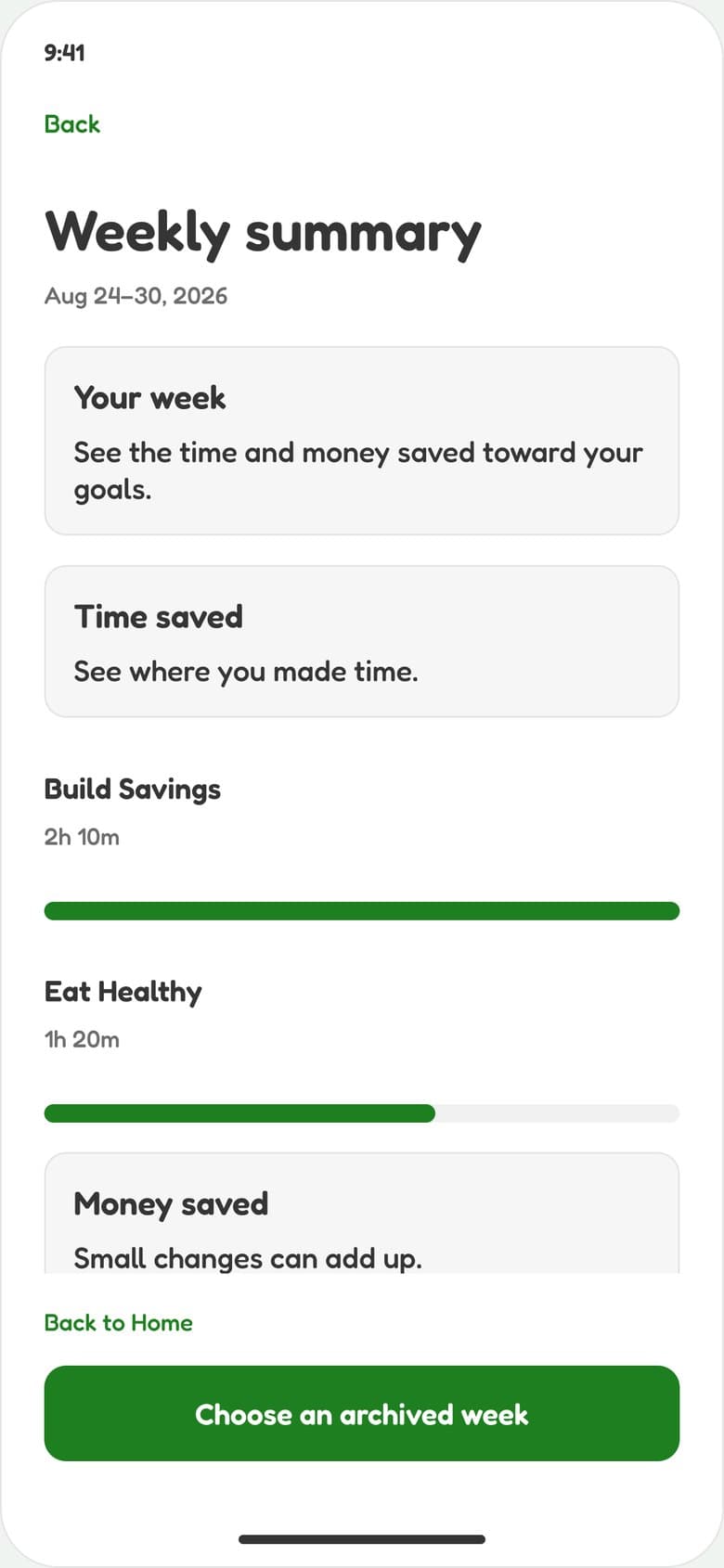
For goals where you want to go somewhere less, the question flips. How much time did those places used to take, and how much are they taking now? NoTestudo compares your time with a typical day for you, starting from your first week of visits. If the bar used to take three hours on a Thursday and this Thursday it took none, those hours show up as time saved.
Because the starting point is your own first week, time saved is about you. It isn’t measured against a stranger’s schedule or an ideal week that nobody lives.
Money saved
Money saved is an estimate of what you didn’t spend. Skip the takeout you’d normally order after practice, and NoTestudo estimates the meal you didn’t buy. You can also add it yourself: when you skip something you’d normally buy, record what you kept.
Money saved is private. It’s never shared with friends or groups, even if you share your streaks with them.
What the numbers can’t tell you
These numbers are honest about their limits, and it helps to know them:
- A visit isn’t an activity. NoTestudo can’t see studying itself, but it can notice time at the library. Three hours there might be three hours of deep focus, or one hour and a long lunch. Only you know.
- Estimates are estimates. Money and time estimates depend on your goal and on the tracking and spending information available. Read them as a good guess, not a bank statement.
- A day it couldn’t see is unknown. If your phone was off or location was paused, that day isn’t counted as zero. Absent is not zero.
When a visit is wrong
Location isn’t perfect, so the record has to be fixable. If NoTestudo got a visit wrong, you can correct it. If you stopped somewhere for less than three minutes, like grabbing a coffee at the counter, you can count that visit yourself. And if you need a break from a goal, you can pause it rather than letting the numbers run without you.
Daily, weekly, monthly
The same numbers show up at three zoom levels. A daily recap is ready the morning after. The weekly summary adds up your week, goal by goal. A monthly recap shows the longer arc, which is where small changes start to look like something. Each one answers a different question: what happened yesterday, how did this week go, and is the direction holding.
Why real units help
There’s something steadying about progress you can picture. “Four hours at the library this week” is a fact you can feel. So is “forty dollars still in my account because I skipped late-night delivery three times.” Neither one judges you. Both tell you what changed.
And because the numbers compare you with your own past weeks, they don’t turn into a contest. A week with less time invested than the last isn’t a loss. It’s information. Maybe midterms moved your studying to a different building. Maybe you were sick. You get to decide what it means.
A five-minute Sunday habit
NoTestudo’s weekly summary adds up your week for you, and you can leave yourself an optional Sunday note. When you open it, look at three things:
- Where your time went, place by place.
- What you kept, in hours and dollars.
- One thing you’d like to be different next week.
Five minutes, no verdict. Then close the app and go live the next week.